
IRFC 7.53% Tax-Free Bonds – December 2015 Issue
This post is written by Shiv Kukreja, who is a Certified Financial Planner and runs a financial planning firm, Ojas Capital in Delhi/NCR. He can be reached at [email protected]
IRFC 7.64% Tax-Free Bonds Issue – Tranche II – March 2016 Issue
It has been a very long time since NHAI filed the draft shelf prospectus for its tax-free bonds issue in the first week of October. Investors have been desperately waiting for a bigger issue as all the previous issues by NTPC, PFC and REC have left them fairly disappointed.
All these issues were of smaller sizes of Rs. 700 crore each and got hugely oversubscribed on the first day itself. But, before NHAI could make it, IRFC has taken the lead to launch its tax-free bonds from the coming Tuesday i.e. December 8th.
As the issue size is quite big, I hope it does not get oversubscribed on the first day itself and the retail investors get full allotment at least this time around. The issue is scheduled to get closed on December 21st.
Before we analyse it, let us first quickly check the salient features of this issue:
Size of the Issue – IRFC is authorized to raise Rs. 6,000 crore from tax free bonds this financial year, out of which the company has already raised Rs. 1,468 crore by issuing these bonds through private placements. The company will raise the remaining Rs. 4,532 crore in this issue.
Coupon Rates on Offer – REC offered 7.43% as its highest rate of interest for the 20-year investment period. Due to a sharp reversal in G-Sec rates, coupon rates for this issue have risen by 0.07% to 0.19%. IRFC will offer yearly rate of interest of 7.32% for its 10-year option, 7.53% for the 15-year option and 7.50% for the 20-year option to the retail investors investing less than or equal to Rs. 10 lakh.
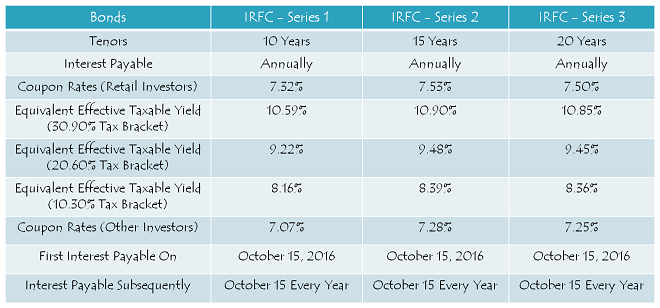
As always, these rates would be lower by 25 basis points (or 0.25%) for the non-retail investors.
Rating of the Issue – CRISIL, ICRA and CARE consider investing in these bonds to be safe and as a result, have assigned ‘AAA’ rating to the issue. Also, these bonds are ‘Secured’ in nature and in case of any default, the bondholders would carry a right to make claim on certain assets of the company.
NRI/QFI Investment Allowed – Non-Resident Indians (NRIs) are eligible to invest in this issue, on a repatriation basis as well as non-repatriation basis. Unlike earlier issues, Qualified Foreign Investors (QFIs) are also allowed to invest in this issue.
Investor Categories & Allocation Ratio – The investors have been classified in the following four categories and each category will have certain percentage of the issue size reserved during the allocation process:
Category I – Qualified Institutional Bidders (QIBs) – 15% of the issue is reserved i.e. Rs. 679.80 crore
Category II – Non-Institutional Investors (NIIs) – 20% of the issue is reserved i.e. Rs. 906.40 crore
Category III – High Net Worth Individuals including HUFs & NRIs – 25% of the issue is reserved i.e. Rs. 1,133 crore
Category IV – Resident Indian Individuals including HUFs & NRIs – 40% of the issue is reserved i.e. Rs. 1,812.80 crore
Allotment on First Come First Served Basis – Subject to the allocation ratio, allotment will be made on a first come first serve (FCFS) basis in each of the investor categories, based on the date of upload of each application into the electronic system of the stock exchanges.
Listing & Allotment – IRFC has decided to get these bonds listed on both the stock exchanges, National Stock Exchange (NSE) as well as Bombay Stock Exchange (BSE). The company will allot the bonds and get them listed within 12 working days from the closing date of the issue.
Demat A/c. Not Mandatory – It is not mandatory to have a demat account to apply for these bonds. Investors have the option to subscribe to these bonds in physical form as well. Whether you apply for these bonds in demat or physical form, the interest payment will still get credited to your bank account through ECS.
Also, even if you get these bonds allotted in an electronic form, you have the option to rematerialize your holding in physical/certificate form if you decide to close your demat account in future.
No Lock-In Period – These tax-free bonds are freely tradable and do not carry any lock-in period. The investors may sell them at the market price whenever they want after these bonds get listed on the stock exchanges within 12 working days of the closing date.
Interest on Application Money & Refund – Successful allottees will earn interest at the applicable coupon rates on their application money, from the date of realization of application money up to one day prior to the deemed date of allotment. Unsuccessful allottees will get interest @ 5% per annum on their refund money.
Minimum & Maximum Investment – Investors are required to put in a minimum investment of Rs. 5,000 in this issue i.e. at least 5 bonds of face value Rs. 1,000 each. There is no upper limit for the investors to invest in this issue. However, an investor investing more than Rs. 10 lakhs will be categorized as a high networth individual (HNI) and will get a lower rate of interest as applicable.
Interest Payment Date – IRFC will make its first interest payment on October 15 next year and subsequent interest payments will also be made on October 15 every year.
Record Date – For the payment of interest or the maturity amount, record date will be fixed 15 days prior to the date on which such amount is due to be payable.
Should you invest in this issue?
Long-Term Potential – While the sentiment for real estate and gold investments has already been pretty negative, stock markets are once again testing risk appetite of the retail investors. Conservative investors can do nothing but invest in fixed deposits or explore some other relatively safer options like debt funds or tax-free bonds.
A sharp reversal in the G-Sec yield has again given an opportunity to the investors to invest at higher coupon rates. I personally think that India should have a relatively lower inflationary scenario in the next 3-5 years as compared to the previous few years. If you also have the same view and if you want to earn tax-free interest on your investments for the longest possible period of time, then I think you should opt for the 20-year bonds which carry 7.50% rate of interest. The 15-year option with 7.53% is also equally attractive with a relatively shorter investment period.
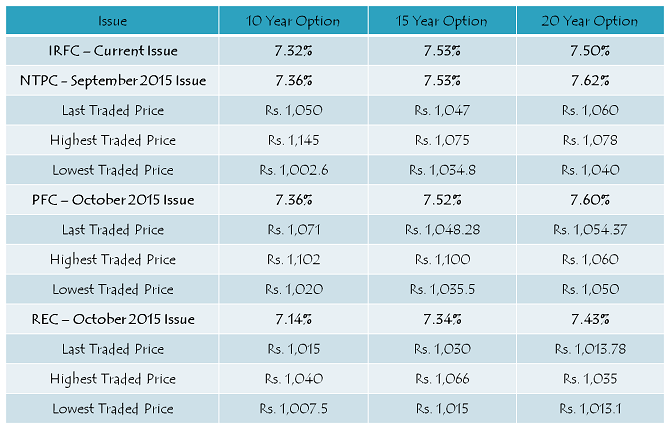
Listing Gains – IRFC is offering 7.53% rate of interest for its 15-year option, which is also the highest rate of interest for its bonds across all three options. NTPC issue also carried the same 7.53% rate of interest for its 15-year option. As you can check from the table above, NTPC 15-year bonds last traded at Rs. 1,047 on Friday on the NSE i.e. a 4.7% premium to its issue price. Even if I consider Rs. 12-15 premium to be the accrued interest for the 2-month period since listing, these bonds are still earning a natural premium of approximately 3-3.50%.
Even the REC 15-year bonds, which got listed on November 5th on the BSE and carried a lower rate of interest of 7.34%, got traded at Rs. 1,030 on Friday i.e. a premium of 3% including one month’s accrued interest. This observation makes me believe that there is a scope of making some quick short-term listing gains with IRFC bonds as well.
Application Form for IRFC Tax Free Bonds
Note: As per SEBI guidelines, ‘Bidding’ is mandatory before banking the application form, else the application is liable to get rejected. For bidding of your application, any further info or to invest in IRFC tax-free bonds, you can contact me at +919811797407
Thanks for detailed info Shiv, looking forward to investing in them & hope we get full allocation considering the issue size.
Hi Ikjot,
I too think 100% allocation should happen this time around. But, demand will be high this time as well.
I am considering to invest a very small amount in fixed deposits, just have dilemma to choose between corporate bonds (aware that they are taxable) vs tax free bonds.. any suggestion on this?
Hi Raj,
Risk & return go hand-in-hand. No low risk fixed income investment would give you more than 10% return. Personally, I would go for safer tax-free bonds for my safe investments. For riskier investments, I would go for direct equity investment or equity mutual funds, as compared to corporate NCDs.
Thanks for the information given in details. Please let me know by mail, can
a investor may apply more then one application.(total sum of multiple form
is less then 5 lac).
Kindly let me know as early as possible.
THANKS……..
TH
Yes Mr. Sain, an investor can submit multiple applications and still get considered as a retail investor if his/her total investment amount is less than or equal to Rs. 10 lakh.
Thank you Shiv ! How come IRFC got AAA this time, last time I remember they were AA ?
Thanks !
they had always been AAA
Yes KK, as Dr. Puneet correctly pointed out, IRFC issues always carried ‘AAA’ rating. Here is the link to its last issue covered here on OneMint – https://www.onemint.com/2013/12/28/irfc-tax-free-bonds-8-65-january-2014-issue/
Ok.. Thanks to both of you.
I already invested 10 Lakh in previous trenches of IRFC. If I invest another 10 Lakh – will I still be considered as Retail investor? Is each trench considered as separate instrument for determining retail investor status?
Thank you Shiv. Is investing < 10L considered as a retail investor?
Hi Vikas,
Yes, Rs. 10 lakh or less investment is considered to be a retail application.
Hi Shiv,
I have already invested 10 lakh in 2013 IRFC bond. Can I invest more in this round under retail investor category or now I will not fall under retail category?
Hi Amd,
Even if you invest Rs. 10 lakh in this issue, you will still be considered a retail investor.
What is the subscription status? how much % allotment one can expect?
As things stands you will get 100%
Hello George,
Which link we should use to see this ?
Also reserve some fund for next issue which will have better coupon rates.
looks like it will will be 90+%
Even after 4PM also bid is happening which means 80-90% allotment only expected.
It should be around 80-85%.
Is that for 1000 cr or 4,532 crores?
It will be for Rs. 1,812.80 crore in the retail investors’ category.
why do you think later issues will have better rates?
The TF Bonds coupon rate is fixed based on GILT. Gilt coupon rate is quoting high.
Retail category investors can expect the allotment @77%. (approximate)
Thanks Shubh for accurate info!
Congrats to all those applied 🙂
Thanks Chaitanya! 🙂
has 4500 crores been exhausted today?
Yes SB, the issue has received subscription worth Rs. 10,796.30 crore, 2.38 times of Rs. 4,532 crore.
Hello Shiv,
What is the final % of allocation ? Thanks !
Hi KK,
It is approx. 77% allocation to the retail investors.
Can you please update on subscription status for today?
Day 1 (December 8) subscription figures:
Category I – Rs. 3,375.02 crore as against Rs. 679.80 crore reserved – 4.96 times
Category II – Rs. 3,023.96 crore as against Rs. 906.40 crore reserved – 3.34 times
Category III – Rs. 2,039.29 crore as against Rs. 1,133 crore reserved – 1.80 times
Category IV – Rs. 2,358.03 crore as against Rs. 1,812.80 crore reserved – 1.30 times
Total Subscription – Rs. 10,796.30 crore as against total issue size of Rs. 4,532 crore – 2.38 times
Great response to this issue as well. NHAI should be encouraged with such a response.
When the issue was so highly oversubscribed on 1st day itself, that everyone will get allotment for only 50%, why did it remained open on 2nd day ???
Though, I m not sure if it was open Today.
Hi Rohit,
It remained open today and will remain open tomorrow as well because the company (IRFC) is required to officially announce the closure of the issue and get an ad published in the newspaper before closing it. So, the ad will get published tomorrow and the issue will stand closed.
Thanks Shiv.
We Retail Investor are classified as Category IV (application less than Rs 10 lacs).
Its shown as oversubscribed to 6.07 times, which effectively means 1.33 times (6.07/4.53), so we will get allotment equal to 75% of our application.
Is this correct ???
Hi Rohit,
Allotment will be made on the basis of the first day’s subscription. It was oversubscribed by 1.30 times on the first day, so 77% allotment will be made to each retail investor.
Thanks Shiv. You are a genius.
Best of luck, in all your work.
Thanks a lot Rohit for your kind words & wishes! 🙂
Shiv,
You’ve been providing nice and useful information.
Many thanks.
Rakesh
Thanks Mr. Rakesh for your kind words!
Hi Shiv,
The previous two tax free bonds alloted the bonds in pro-rata basis. Will this bond also do, or it will do FCFS? If FCFS, then we cannot apply now, as retail portion is already oversubscriped, right? Please help to clarify.
Hi Ashish,
Bonds will be allotted on a pro-rata basis only to those applicants who applied for it on the first day itself. Investors who have applied for these bonds today will not get any allotment. So, even though you can still apply for these bonds, you will not get any allotment.
Day 2 (December 9) subscription figures:
Category I – Rs. 3,375.02 crore as against Rs. 679.80 crore reserved – 4.96 times
Category II – Rs. 3,023.27 crore as against Rs. 906.40 crore reserved – 3.34 times
Category III – Rs. 2,038.79 crore as against Rs. 1,133 crore reserved – 1.80 times
Category IV – Rs. 2,426.58 crore as against Rs. 1,812.80 crore reserved – 1.34 times
Total Subscription – Rs. 10,863.66 crore as against total issue size of Rs. 4,532 crore – 2.40 times
subscribing to comments..
Day 3 (December 10) subscription figures:
Category I – Rs. 3,375.02 crore as against Rs. 679.80 crore reserved – 4.96 times
Category II – Rs. 3,024.27 crore as against Rs. 906.40 crore reserved – 3.34 times
Category III – Rs. 1,991.54 crore as against Rs. 1,133 crore reserved – 1.76 times
Category IV – Rs. 2,444.59 crore as against Rs. 1,812.80 crore reserved – 1.35 times
Total Subscription – Rs. 10,835.42 crore as against total issue size of Rs. 4,532 crore – 2.39 times
This issue stands closed today – http://www.bseindia.com/downloads/ipo/Early%20Closure%20Advertisement_101220151028.pdf
Hello Shiv,
Can you please help us know as what all TFBs apart from NHAI are in pipeline to come before March 16 ?
Thanks
Hello KK,
Please check this post – https://www.onemint.com/2015/07/18/tax-free-bonds-notification-fy-2015-16/
After NHAI, only HUDCO & IREDA are left to issue these bonds. HUDCO is authorised to issue Rs. 5,000 crore worth of tax-free bonds this financial year and IREDA Rs. 2,000 crore.
Ok.. Thank you Shiv !
NHAI Bonds opening on 17th Dec.
Highest interest rate for Retail investors at 7.60% for 15 years.
Retail Book Size – 4000 Crs. Should be 100% allotment, if you apply on Day 1.
Thanks Mayur for this info! You posted this info here even before I could do that.
NHAI tax-free bonds issue update:
Issue opens 17th December, closes 31st December.
Issue size Rs. 10,000 crore.
Interest Rates for Retail Individual Investors investing upto Rs. 10 lacs:
10 years – 7.39% p.a.
15 years – 7.60% p.a.
NRIs are not eligible to apply in the issue. Also, demat account is NOT mandatory for this issue as well.
It is doubtful whether the refund of IRFC will get credited by 17th. Delay of 1 or 2 days would have helped.
Hi George,
If the retail portion does not get oversubscribed by 18th, then there is a possibility of getting the IRFC refund amount channelised into this one.
It is likely that the retail quota will spill to 3rd day, but if it get fully subscribed on 3rd day it will be oversubscribed and partial allotment. The chances of IRFC refund on 18th is quite high.
Yes, highly likely.
Thanks so much Shiv for these updates… very helpful!!!
Thanks Chaitanya!
so dear shiv are you personally investing in a 15 year option or not because last time you have invested in national housing bank taxfree bonds and then I have also invested in nhbtf2014 & nhbtf2023 both with 20 years options and these bons are currently trading on huge premium so are you personally interested in nhai because 15 years option is quite good enough on the current senario
Hi Nitesh,
Personally, I would invest in equities at present as compared to tax-free bonds. But, for a conservative investor, NHAI tax-free bonds offer a good opportunity.
Bollywood Actors are too investing in tax-free bonds – http://m.economictimes.com/markets/bonds/stars-bond-with-tax-free-savings/articleshow/50148968.cms
Hi Mr. Shiv,
I am an NRI. Is there any tax free bond which we can buy in secondary market. would appreciate your advise and recommendation.
Hi Mr. Srikrishnan,
You can buy tax-free bonds which are having the highest YTM. You should contact your financial advisor for finding the best one for you as per your investment horizon.
When will irfc allottments start?
Hi
Where to check allotment status and when?
Thanks for a huge wide and complete information. Have the IRFC allotted the bonds and started for refund ? if not then expected time.
Not Yet. I think that IRFC has 12 days time from date of closing.They may decide to utilise this fully.
IRFC has started the allotment today. They have deducted amount today which was blocked under ASBA.
Oh that is great, thanks for providing this info Pankaj!
i got my 21% refund an hour before
Yes 21 % was the refund.
dear shiv
i applied for 750irfc35 but was allotted 753irfc30.
what could be the reason?
Hi Dr. Puneet,
That is just not possible. There is some goof up in bidding of your application. Please check with your broker.
ok thanks
Are these bonds already showing up in your demat account (NSDL/CDSL) or did you get sms of allotment details? I received sms of refund but have not yet got sms of allotment from NSDL. How did you know you got alloted 753irfc30. Is there an online link to check application status in karvy or linkintime.
Shiv, any idea when these bonds are going to list.
Many thanks.
my demat a/c was showing these bonds at 11.30 pm last night.moreover i got an sms and refund as well.
ok, my NSDL account is now showing this, received sms also just now
INE053F07843 INDIAN RAILWAY FINANCE CORPORATION LIMITED SR-104A 7.5 LOA 21DC35 FVRS1000
I had applied for 20 year option under retail quota
Hi Bhaskar,
I think these bonds should get listed on Thursday i.e. 24th December.
Allotted bonds are showing up in NSDL. But no SMS.
dear shiv i have applied for irfc tfb . i got allotment. but i did not get refund balance amount . i apply under NRE Dement a/c . so can you guide me regarding this issue to whom i need to contact for refund with my bank or IRFC.
thanks
Hi Nisar,
Refund amount must have got credited to your bank account yesterday, please check. If it is still not there, you can contact Karvy Computershare on 1800 3454 001.
dear Shiv in link is showing that refund is credited to my bank account on 21-12-2015 but not credited to my bank account yet. so i need to call Karvy Computershare on 1800 3454 001. is it ? or i can send mail to them.
Hi Nishar,
You can call Karvy Computershare on 1800 3454 001 OR write a mail to them on [email protected]
dear Shiv
thank you very much
You are welcome Nishar!
Link to check the allotment status of IRFC tax-free bonds – http://kosmic.karvy.com:81/ipotrack/
IRFC tax-free bonds to get listed on the BSE & NSE on December 28th i.e. Monday – http://www.bseindia.com/markets/MarketInfo/DispNewNoticesCirculars.aspx?page=20151223-7
Here are the BSE & NSE codes for the same:
7.32% 10-year bonds – BSE Code – 935572, NSE Code – NI
7.53% 15-year bonds – BSE Code – 935574, NSE Code – NJ
7.50% 20-year bonds – BSE Code – 935576, NSE Code – NK
Deemed date of allotment has been fixed as December 21, 2015. Interest will be paid on October 15th every year.
Hi Shiv,
Will it be a good strategy to sell IRFC 7.53% bond on Dec 28 and invest the proceeds in NHAI 7.60%? Any chance of NHAI retail portion getting over-subscribed before that?
Yes Jason, it will be a good strategy to do that given you get a decent premium of 1-3% after brokerage & statutory taxes.
Dear All, I applied through ICICI Direct and the amount is deducted but in “History”, it shows “0” in allocated bonds. Nor does it show up in my Demat Allocation. Is it a cause for concern or the allocation process is still on?
Hi Malcom,
I think allotment process is complete and bonds have been allotted to all the successful allottees now. First, you should check your allotment status on this link – http://kosmic.karvy.com:81/ipotrack/ and if it is not showing here on this link, then you should contact your broker first and then Karvy Computershare, the Registrar for IRFC bonds issue.
On ICICIDirect site, go to demat allocation where you see all other bonds if any. There is a “Allocate” button. Click that button and there you will find those bonds. You will have to allocate bonds manually by entering quantity in the text box. Bonds are in your demat account but you will have to explicitly allocate them for trading only then it will show up. In trading history it will show 0 for some time(1 month)
Thanks, Shiv. The link gives the shares allotted and amount refunded. I got the refund amount but the Demat balance shows 0. Perhaps I need to wait for some time?
That’s right Malcom, you should wait at least till these bonds start getting traded on the exchanges. Thanks!
Finally got it in my Demat. Has the trading started?
Hi Shiv,
I regard you as an expert in Bond Market.
You had following expectations from IRFC.
“Listing Gains – IRFC is offering 7.53% rate of interest for its 15-year option, which is also the highest rate of interest for its bonds across all three options. NTPC issue also carried the same 7.53% rate of interest for its 15-year option. As you can check from the table above, NTPC 15-year bonds last traded at Rs. 1,047 on Friday on the NSE i.e. a 4.7% premium to its issue price. Even if I consider Rs. 12-15 premium to be the accrued interest for the 2-month period since listing, these bonds are still earning a natural premium of approximately 3-3.50%.”
Now, Actual Listing must hav surprised you, like most ppl.
How would you understand this ??
Where this Natural Premium vanished away ??
Asking, just to understand this Bond market in a better way.
it is because 760 nhai 30 was available to invest in the mean time. moreover the interest being paid was more
look at the above mentioned comment of jason. you will get the answer.
Hi Rohit,
NTPC 7.53% bonds today last traded at Rs. 1,036 with only 32 bonds traded on the NSE. Please check this link – http://www.nseindia.com/live_market/dynaContent/live_watch/get_quote/GetQuote.jsp?symbol=NTPC&series=NC
This shows the yield of these bonds has gone up and demand has also decreased in the last 20-25 days. Pricing is a matter of demand & supply and alternate opportunities elsewhere. With IRFC bonds, demand is low at its current yield as investors are getting higher coupon with NHAI and people who invested for listing gains are ready to sell even at their cost. Moreover, bad political scenario with GST not getting passed in the Winter session of Parliament also had its negative side effects on the bond yields. But, I think we should have a gradual recovery going forward.
Good analysis Shiv. You have summed it up very well. Markets are vulnerable due to micro and Macro economic reasons. But still the TFB are a good bet considering tax free coupon assured at reasonable rates. Definitely current issues are not going to help those who are looking for quick bucks soon after listing. I sold few of my NTPC bonds for 1065 after listing, I had opportunity to sell it at 1075 later but still retained remaining. At the end of the day investor goal defines his intent.
IREDA 7.74% Tax-Free Bonds Issue – https://www.onemint.com/2016/01/02/ireda-7-74-tax-free-bonds-january-2016-issue/
HUDCO tax-free bonds issue update:
Issue opens – 27th January
Issue closes – 10th February
Base Issue Size – Rs. 500 crore
Total Issue Size – Rs. 1,711.50 crore
Interest Rates for Retail Individual investors investing upto Rs. 10 lacs:
10 years – 7.27% p.a.
15 years – 7.64% p.a.
HUDCO 7.64% Tax-Free Bonds Review – https://www.onemint.com/2016/01/21/hudco-7-64-tax-free-bonds-tranche-i-january-2016-issue/
IRFC will raise an additional Rs. 3,500 crore by issuing tax-free bonds this financial year – http://www.financialexpress.com/article/economy/indian-railway-finance-corporation-gets-rs-3500-crore-more-tax-free-bond-limit/211014/
NHAI Tranche II update:
Issue opens – 24th February, 2016
Issue closes – 1st March, 2016
Interest Rates for Retail Individual Investors investing upto Rs. 10 lacs:
10 years – 7.29% p.a.
15 years – 7.69% p.a.
Total Issue Size – Rs. 3,300 crore, including Green-Shoe Option to retain Rs. 2,800 crore
HUDCO Tranche II update:
Issue opens – 2nd March, 2016, Issue closes – 10th March, 2016
Interest Rates for Retail Individual Investors investing upto Rs. 10 lacs:
10 years – 7.29% p.a.
15 years – 7.69% p.a.
Total Issue Size – Rs. 1,788.50 crore, including Green-Shoe Option to retain Rs. 1,288.50 crore
Shiv, Is IRFC also coming out with bonds in March ?
Yes Raj, IRFC will be launching its second issue of tax-free bonds in March.
NABARD Tax-Free Bonds Issue Update:
Issue opens – 9th March, 2016, Issue closes – 16th March, 2016, Issue Size – Rs. 3,500 crore
Interest Rates for Retail Individual Investors investing upto Rs. 10 lacs:
10 years – 7.29% p.a.
15 years – 7.64% p.a.
I want to understand on the liquidity part of these tax free bonds.
IRFC is offering 10 years – 7.29% p.a. & 15 years – 7.64% p.a.
My concern is that though this is beneficial for me being in the 30% income bracket but otherwise the returns are too low . What if i want to sell them after 3-4 years if i get a better opportunity due to increase in interest rate cycle or due to other opportunities. Is there any liquidity risk because i can hardly see any buyer or seller on the exchanges in retail category.
Hi Shiv,
I invested in both NTPC and IREDA and was allotted some share of my Applied number of bonds. But when these bonds are listed in my Demat Account, it is showing a NAV of zero (0) whereas for bonds like NHAI etc. it is showing values like 1029/1030 etc. All the bonds are issued in 2015-16. Can you let me know if there is any discrepancy? and if yes, whether it is from Bank end or NTPC/IREDA end.
Thanks,
Amit
Thanks for the information!